



Hi — I’m Tye, and I’m on a mission to find and tell the stories of how people are carrying culture forward through everyday food. Follow along by subscribing below. No Substack account required.
Hello, family, and welcome to Issue 8.
Since spending time in Portugal last summer, I find myself thinking about the food more than I expected. The preparations are simple. You can taste every ingredient.
But Portuguese food is hard to find in the States. Outside a few strongholds, it has never become as visible here as many other cuisines.
There’s a notable exception, though: southeastern New England.
Rhode Island, despite being the nation’s smallest state, has historically had the highest percentage of residents reporting Portuguese ancestry of any state in the country. Just across the state line, Fall River, Massachusetts, is home to the largest Portuguese-American population of any U.S. city.
Some of you know I lived in New England moons ago. So, I decided to return with a mission — learn about Portuguese cuisine and its influence on the region.
I tapped my friend Meredith as my exploration companion. Her maternal great-grandparents emigrated from Portugal to the U.S., and her family has lived in the Ocean State since.
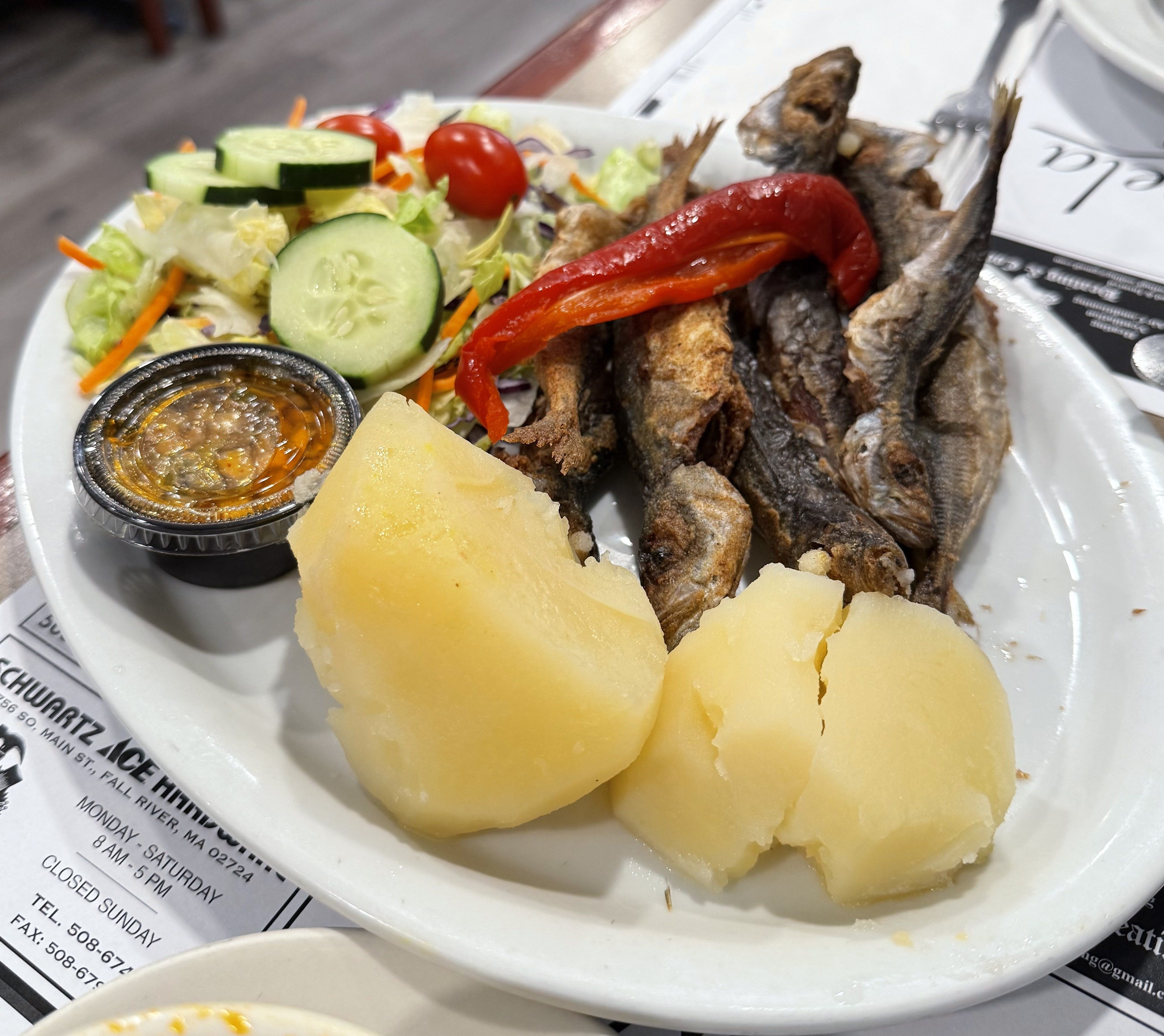
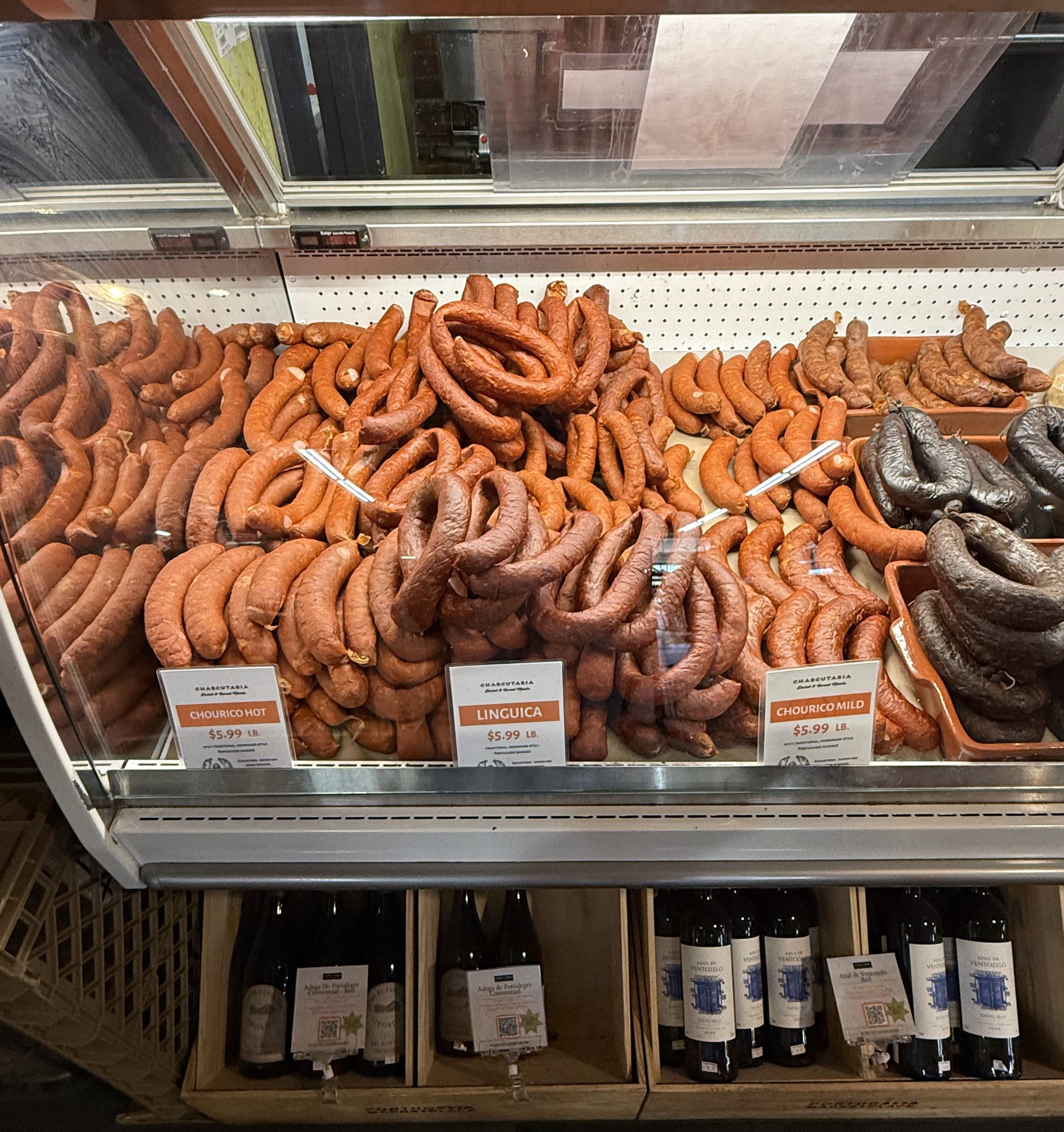
We spent a day together browsing the cases of linguiça at Portugalia Marketplace and trying camarão à Moçambique together for the first time at a local go-to spot, Caravela Restaurant, in Fall River.
Our Fall River outing led to a deeper conversation about the family parties Merrie’s grandparents hosted when she was growing up and the vivid memories she has of the streamers her grandfather hung in his house for her birthday every October.
They drank wine out of the smallest cups you’ve ever seen. It was always red wine— never white. And it was always from the Carlo Rossi jug.
Merrie reminisced that two of her grandparents’ dishes appeared at every family party. The first the family has dubbed Portuguese Rice—so indispensable to their gatherings that Merrie and her cousins eventually had the recipe etched onto a plate for their parents.
The other was her grandparents’ croquetes — seasoned beef wrapped in mashed potatoes, shaped into bite-sized portions, and fried.
Merrie and I followed up for a proper interview about those croquettes, a snippet of which I’m sharing with you here.
So grab a tiny cup, and I hope you enjoy 🍷.
At every party, for all time
This interview has been edited and condensed for readability. Rest assured the sass and heart are all Merrie’s 😉.
Tell us a bit about your grandfather.
He was born Manuel Pereira. His schoolteachers told him that name was too ethnic, so it became Perry at some point.
My grandfather and his siblings grew up in Fox Point, which was the big Portuguese neighborhood in Providence. My grandmother was there too. They all grew up fairly poor.
One story that sticks in my head is he would always talk about how kids who were wealthier would heat pennies on the radiator and throw them out to the kids who had no money, knowing they would try to pick them up because they needed the money.
Did you get to spend a lot of time with them?
Me and my sister spent almost every weekend, at least one night, at my grandparents’ house growing up because, you know, it was the 90s.
When it was just us, my grandmother would make shepherd’s pie. There’s different versions in a lot of different places, but for us, it was a linguiça and hamburger mixture with spices in the middle and peas, mashed potatoes coating it, and then a mashed potato crust that she would put butter on. And then I think she probably just broiled the top. That’s what we would have every weekend.
I loved being there. They were so thoughtful in what they did. They were really good people and that I’m lucky to have had them as grandparents, as are my cousins.
Give us a flavor of what your grandparents’ family gatherings were like.
My grandparents did a huge New Year’s Eve party every year, and they did a lot of summer parties. That’s when they would do the croquettes, which is a variation of shepherd’s pie because it’s meat rolled in mashed potatoes, rolled in breading and egg wash, and then fried. So it’s a shepherd’s pie variation, but it’s handheld.
We would always do that, the rice that had no flavor, and a can of corn. The appetizer was always this section dish with black olives, green olives, and pickles.
That was the menu, every party, for all time, no matter the time of year. Sometimes fried linguiça too.
When is the last time you remember eating that meal together?
Right before my grandparents went into the nursing home, and my grandfather died very shortly thereafter, my cousins and I went for an adult sleepover at their house. We were full-grown adults.
We had the shepherd’s pie. My sister and I liked ours with peas, while my cousins liked theirs with corn, so my grandparents made two different shepherd’s pies—one with peas and one with corn.
That is the last time I remember eating there in that house with them before they went into the nursing home.
I hadn’t thought about how they always made different shepherd’s pies for the different cousins. One set of cousins liked corn, and the other liked peas, so they made both. I’m sure they were so happy we were there.
When the family makes the croquettes now—do they taste the same?
No, absolutely not. Like, not even close.
Everyone’s done their best. It’s just not the same because my grandparents had this dirty-ass electric frying pan. You know, those ones that you plug in. And so it was a special piece of machinery that I don’t think anyone has. I’m sure it got thrown out when they died.
They would do it in batches. The two of them would stand there, and there’d be a dredging station—the egg station, the breadcrumb station. And then they’d put it all in this frying pan. You can’t really recreate that.
It happens very rarely that these are made; now it’s a special thing.


You don’t eat meat anymore. Don’t you miss the croquettes?
The last party we had them at, my aunt made me vegetarian croquettes so I could experience them again. It had never been done before; my grandparents were huge meat eaters. They were actually really good. I think she used mushrooms.
When I say it out loud, I’m realizing my family is really nice.

Merrie told me that like clockwork, every time her grandfather’s rice was served at a family gathering, someone commented that it needed more salt.
No one would dare change the recipe.